

In this article I will talk about the conversion rate of a web page and what is its correct definition and especially its role within a marketing strategy.
The Conversion Rate is just a small puzzle in a larger picture that allows you, if you put it in the right place in the figure, to have a clear view of the direction your business will take.
I often find myself, both in courses and while video conferencing with clients, talking about conversion rate and what a web page, landing page or e-commerce should ideally yield.
“How much is the average in my market? How much will my page be able to convert?”
You may not believe it, but it is one of the most frequently asked questions.
WHEREAS, we must always consider the famous three variables of the tatami law (here
you can find the explanation
) I think it is essential to shed some light on conversion rate, what its correct definition is, and most importantly, its role within a marketing strategy.
But what is the Conversion Rate (TC)?
Il Tasso di Conversione, o Conversion Rate (CR), è la percentuale di utenti del sito che ha eseguito l’azione per cui la pagina web è stata progettata.
Example: 20 people in the last month have downloaded your ebook from your squeeze page? Did you have a total of 400 unique visitors? Well, your conversion rate is 5%.
Already starting from this simple definition, we can easily deduce that not all conversions have the same value; getting comments, interactions and shares in an informative post has a different value than getting a free ebook download in exchange for an email.
Getting sales or requests for quotes is even more valuable.
Even within the same offering, an ebook may be more or less appealing depending on its ability to intercept and satisfy the search intent of those who landed on the squeeze page.
We can say that, if we want to get more conversions, as user engagement and exposure to us increases, it will have to be matched by greater motivation and a stronger ability to persuade them.
In the speech for the 2015 WMF I explained how, in my opinion, it is useful to imagine the conversion process inverted, like a steep mountain to be climbed, on the top of which the user will be able to find the solution to his problem or the satisfaction of his need.
The more motivated the user is to reach out, the more likely they will accept our offer.
In this scenario, the User Experience has the task of making him feel comfortable, reducing the obstacles that separate him from conversion.
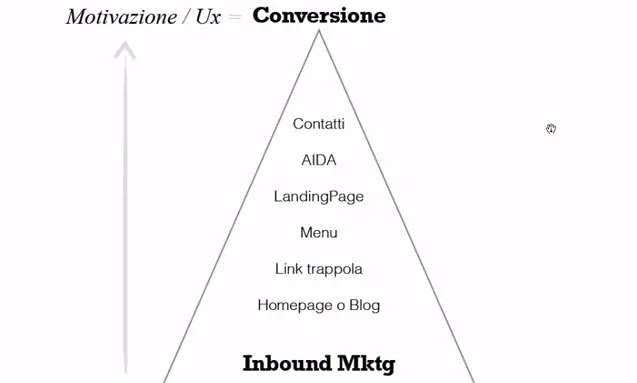
In the speech I talked about how you can improve conversions of a website
working on the UX and reducing the obstacles the user finds in his or her path.
In traditional web marketing, on the other hand, conversion is portrayed in the totally opposite way, as a funnel into which users from the various traffic sources flow together and then, almost by gravity, descend downward, getting closer and closer to our goal.
Having developed more than a hundred projects in completely different fields I can tell you that such a situation-as long as it is possible-is quite rare.
Well, defined that each bid has different barriers to entry, we can now divide these blockers into two categories:
- factors over which we can have control
(e.g. our price) - factors over which we cannot have control
(e.g., the presence of express demand)
In marketing, these elements are well represented in the famous swot matrix that highlights our strengths and weaknesses (internal factors, of which we have control) and market opportunities/threats (external factors, of which we have no control).
This is the main reason why a consultant will be more cautious in his “outcome promises” than someone who sells training and drops you at the end of the course: after an initial briefing it is very difficult to get a clear picture of the market and the variables that may contribute to the success or failure of your project.
Typically what we do with the client is to define a strategy that is as safe, straightforward, and without wasting money as possible to reach the goal…but it is a journey that we take together, gradually finding solutions to the different problems we will encounter on our way.
My job, for example, is not only to create the Effective Landing Page but, rather, to figure out how to generate the expected results if the generated contacts are less than expected.
The verification and correction phase is so important that on best practices I even wrote a 300-page book explaining each step of my method.
Think about it, if it was all there it wouldn’t make much sense to reveal all my secrets.
Creating an effective landing page is only the beginning and aims to create a sales tool that can support advertising costs by bringing a return on active investment.
After phase1 I move with my clients to a phase2 that involves other activities such as reducing the cost of acquisition and increasing the average value of each client.
THEN THERE ARE THE OUTSIDERS.
In one famous experiment Bencivenga and Rosenthal bet on a 10 percent increase in roi over previous campaigns, even offering to refund all advertising costs incurred if they did not win the bet.
Techniques of this kind, undoubtedly useful to those who propose them, turn out to be for those involved in web sales what they really are: clever illusions.
Their real goal is not to prove the effectiveness of the method by offering a guarantee but, rather, to create an excess of demand from which to select the most “suitable” companies.
What are these companies?
Simple, the ideal target audience for such an offer might be:
- Those who will not have the ability to control the RELATIVE increase in roi (because, for example, they did not track previous results correctly),
or,
- Those who have an established and very competitive business that is, however, not properly communicated (read: easy-to-root customers)
But back to our conversion rate and its definition. Peep Laja, one of the world’s most famous conversion experts, used to say:
The right conversion rate?
It is the one higher than yours.
What a nice guy, but will it be true? In my opinion, no, but as much as I disagree, this statement highlights some important things we can learn:
- The current conversion rate only makes sense in relation to the previous conversion rate (and thus it makes little sense to look for and refer to a standard conversion rate for a market).
- The conversion rate has value only in the perspective in which its temporal changes are measured, usually by ab test.
Need to do ab test. The usual response.
But is it possible for each market to do ab test?
No, not if you have a specialized business that targets a niche market with a premium price. Not if you are an Italian pmi, in most cases.
Probably-if you’re good with pcc-you’ll be able to segment traffic very well by reducing the number of clicks and increasing their quality: this, however, clashes with the statistical significance of the tests, which, in niche markets like Italy’s, can rarely be so validated.
I ran several ab tests on my landing pages before I realized that if you are not targeting the general public with a good distributed through GDO you will rarely need an ab test.
The context in which you operate is crucial.
Context. If Google really understood the theme of this post they should index me by this word and not by Conversion Rate 🙂
Despite the good points, however, Laja’s definition has several problems because it does not take into account some important considerations that, those who go deep into things, cannot be spared.
The first of these considerations is offered to us by Rossella Cenini, an Adwords expert and CRO professional. Rosserva helps us understand what the ideal conversion rate might be in an ecommerce.
“The goal of cro in an ecommerce is not to increase the conversion rate but rather to increase revenue for the customer.”
Reread this sentence, and think about it carefully.
Does selling more always mean making more money? NI.
In an ecommerce there may be high-margin products and others just above break-even or, in some cases, even at a loss.
The job of a good technician who is dedicated to optimizing conversions is therefore to guide users to purchase the products with the highest margins.
Try to think about it: considering only conversion rate as a metric of e-commerce effectiveness makes little sense: reducing all prices by 50 percent would increase sales, but certainly not earnings.
Building on this observation, I would like to take it a step further by returning to the topic of Landing Pages. On a landing page, we don’t have many products, but a single offer to which a considerable margin hopefully remains attached: so is it true that a high conversion rate is better than a low one?
No, not even in this case. Not always, at least.
Generally–as I explain well in the book–the first goal of a landing page is to bring in the most conversions by ensuring that the advertising costs are borne by the revenue our client derives from the sales made.
The fact that this is its first goal, however, does not mean that it is the only one: after we have managed to define a baseline, we start working on the quality of conversions by trying to filter out the least interesting users to optimize our resources.
One change can make big differences:
By removing the service charge display in Effective Landing Page I could increase conversions by a good 50-60%, but with what results?
I would probably end up spending all day on the line with potential customers of whom, however, many would not buy for budget reasons.
I would probably end up thinking that in negotiations I am not as good as I think I am when the truth is that it is the people who have not been properly filtered.
The conversion rate, therefore, must be SUBJECT to the quality of the lead we want to receive and also to the possibility of fulfilling-beyond expected expectations-the promises we make at the sales stage.
Spoiler: high-quality leads does not mean receiving ready-to-buy contacts without doing anything but simply sifting through the sieve only the nuggets that are worth collecting, leaving the sand in the river.
We must always remember that on the web today, most sales come through human contact (e.g., in ecommerce) and that leads in order to be turned into customers must be called immediately, within a maximum of 5-15 minutes (I wrote a whole article about this).
If you have to call your contacts 2-3 days later you might as well let it go. You will probably be seen as a salesperson and no longer as someone who is responding to a drop call.
Speaking of lead quality, however, you may have missed the second part of my sentence: The conversion rate must be UNDER the possibility of fulfilling–beyond expectations–the promises we made at the sales stage.
If I asked you right now.
“what is the best salesman in the world?”
What would you say to me?
A shallow or inexperienced entrepreneur would tell me convinced:
“Obviously the salesman who can sell ice to Eskimos!”
Wrong.
I worked in the marketing department of an insurance company for over 6 years, and I can assure you that the best salesperson is not the one who sells the most but the one who sells the most without causing the customer service problems.
Or maybe to the legal department.
Advertising is no joke, and a well-known weight-loss product that promised in its early advertisements to make you slim at night, while you slept, effortlessly knows this.
Great results in terms of sales but then what?
You’ve probably noticed that often the words spoken in commercials change slightly over time, almost as if there were a teacher always watching to correct those who wrote them.
But the work of this “master,” which in the case of advertising is called AGCOM is not free: for the slimming product the penalties enclosed in this order reach almost half a million euros.
Perhaps it would be better to say that the product is not so miraculous and that in addition to its use, a low-calorie diet and a good amount of exercise is strongly recommended-if results are to be achieved.
But what about the conversion rate?
Evidently, again, this cannot be a consideration in isolation from the context.
The problem of salespeople and bidding too push.
Suppose that for the promotion of the next course dedicated to creating effective landing pages you decided to take a salesperson.
His job is to acquire customers among entrepreneurs, the ideal target audience for my course.
The contract is clear: the more he sells, the more he earns.
But what is the limit of the things you can promise my potential customers?
How far can you go to manipulate to sell?
Well, I see you are beginning to understand.
We know that-while meeting with potentially interested people-the conversion rate is given by the promises and how they reflect the target’s desires and are supported by elements of authority…
…But then what? What happens AFTER the sale?
If you are familiar with my method, you know that the only way for a company to thrive in the long run is to think strategically by choosing “the slow but sustainable way to grow,” working to create relationships where its customers are satisfied and happy to be part of the equation:
Money x Solution
BUT what happens when my salesman assures you that you will be able to sell anything, or that by taking advantage of my method you will be able to bill from the beach, without doing any effort?
Create customers automatically, creating a business that doesn’t need you and makes you rich by committing-but on the right activities-on only 4 hours a week.
What a cool promise, too bad the reality is different, especially if you sell consulting (or a service) and not training. With training it could also be simple: if you succeed it is because of my method, if you fail it is because you did something wrong and maybe you have to buy the next course.
With a push salesperson, my sales would probably increase like my income in the bank but my social reputation would suffer more and more over time.
But is my reputation a problem for the seller?
I would say no, being paid on commission when he has burned the brand he can move on and use the same techniques with someone else (perhaps showing the increased revenue figures that are now causing his old employer reputational and even legal problems).
Yes Luca, okay, but we are talking about landing pages here, not salespeople on the ground! Mind you, this is exactly the point: today through affiliate marketing it is possible to become product marketers by creating simple landing pages.
But what if the landing page you create has a high conversion rate because the promises, photos, and testimonials it uses are fake?
As you may have guessed, conversion rate is an important metric but it is not everything and must be evaluated in context. Think about it, even a simple fuel reserve light in the car would be of little use outside of a city context and inserted–perhaps–on an island like Fuerteventura where there is a gas station every 50km.
Context is important; there are no quick conclusions.
Does it therefore make sense to talk about numbers? Of relative conversion rate? Of absolute conversion rate? Probably not.
Probably the only thing you need to aspire to is to create an ecosystem of progressive offerings and services that allow you to approach users, satisfy them beyond their expectations, and-only then-sell again.
Unfortunately, it’s not the easiest thing to sell, but it’s definitely the right thing to do for the good of your business in the long run–this coming from a nutcase who’s been working on SMB conversion rates, every day, for more than five years.
Oh, I forgot! What is the right conversion rate?
There is no right “Conversion Rate.”
The Conversion Rate is just a small puzzle in a larger picture that allows you, if you put it in the right place in the figure, to have a clear view of the direction your business will take.
I hope I have clarified your ideas and remind you that I periodically teach an intensive course that will enable you to create a winning communication strategy and build an Effective Landing Page.
If you liked the post please share it, there is a lot of misinformation and I think your contacts will be really grateful for it; if you have any questions please post them in the comments, we will discuss them together and I will try to be as clear as possible, as always.